[1] 0.8132671Normal Distribution
Sample from Normal Distribution
generate a sample from a Gaussian distribution:
rnorm(n, mean = 0, sd = 1)
Example:
y <- rnorm(n = 100000, mean = 5, sd = sqrt(2))
hist(y, freq = F, ylim = c(0, 0.3))
curve(dnorm(x, mean = 5, sd = sqrt(2)), col = 2, add = T)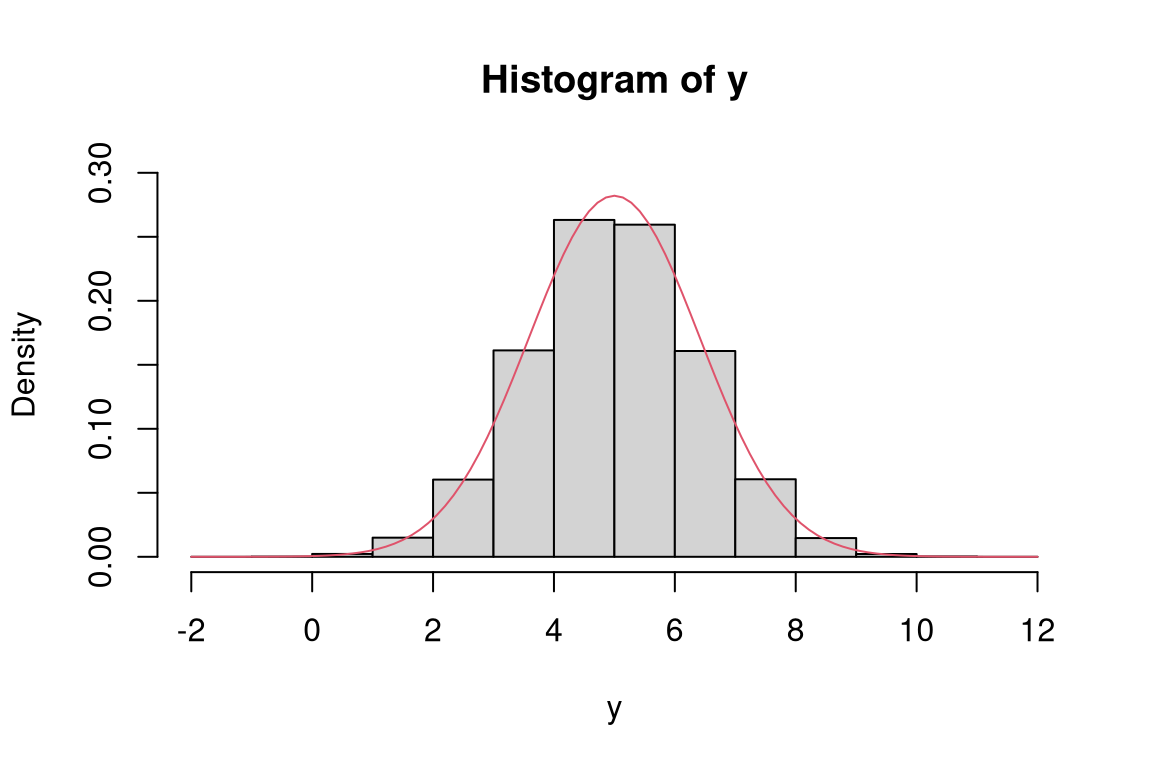
Density function (pdf) of Normal Distribution
Calculate pdf of Normal distribution:
dnorm(x, mean = 0, sd = 1)
y <- rnorm(n = 100000, mean = 0,sd = 1)
hist(y, freq=F, ylim = c(0, 0.4),breaks = 100)
dnorm(-1)
hist(y, freq = F, ylim = c(0, 0.4), breaks = 100)
abline(v = -1, lty = 2)
abline(h = dnorm(-1), lty=2)
[1] 0.2419707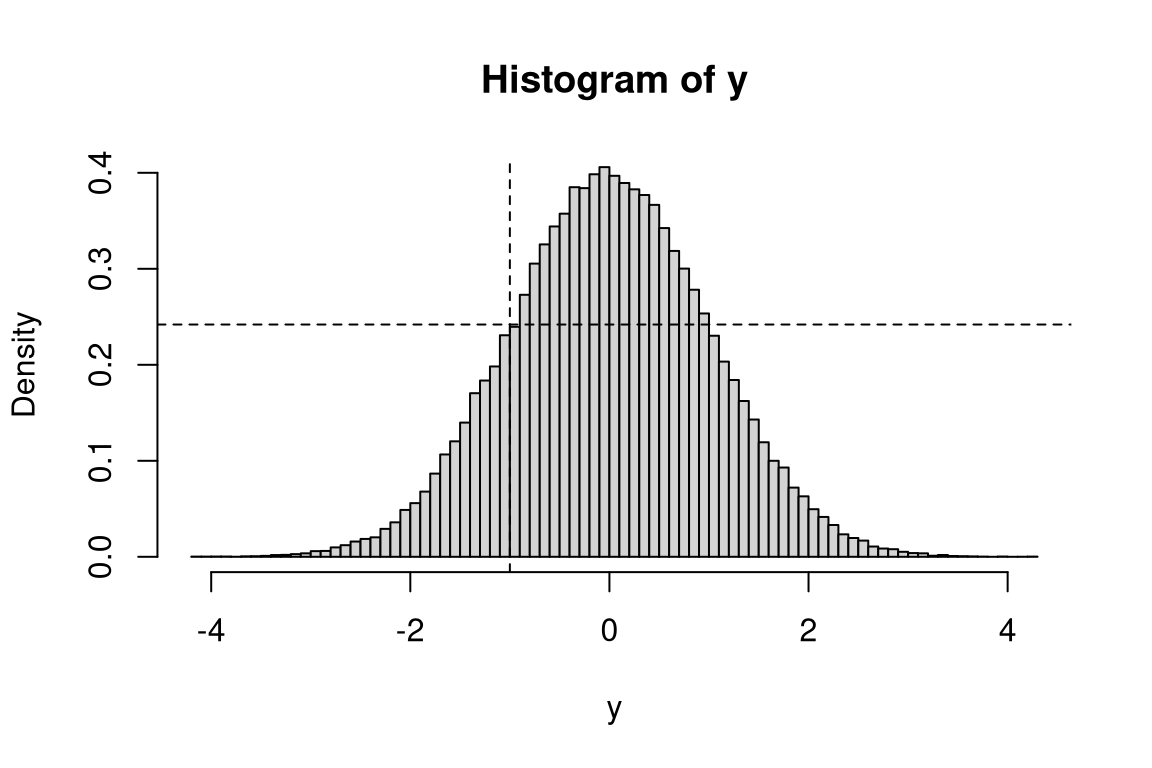
Cumullative Density function (cdf) of Normal Distribution
Calculate pdf of Normal distribution:
pnorm(q, mean = 0, sd = 1)
[1] 0.1586553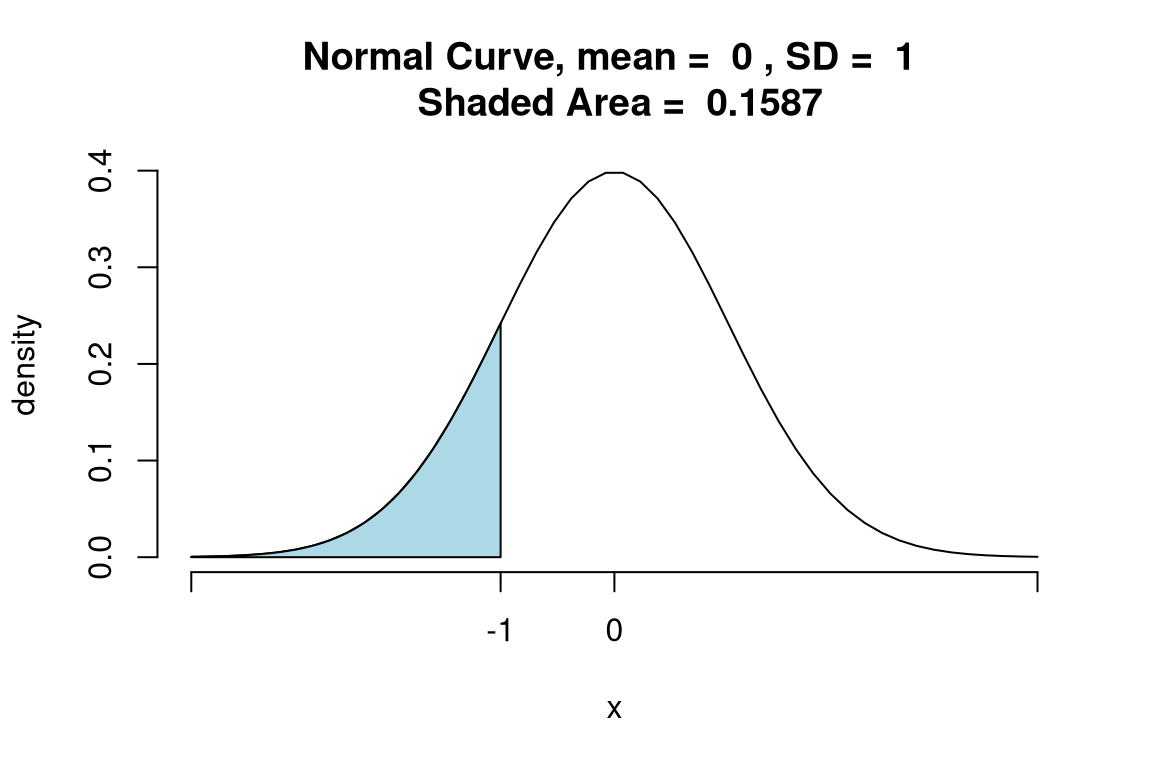
[1] 0.1586553Cumullative Density function (cdf) of Normal Distribution
library(tigerstats)

plot(ecdf(y),main = "Empirical Cumulative Distribution Function")
abline(v= quantile(ecdf(y),0.158655254), lty = 2)
abline(h= pnorm(-1), lty = 2)
text(x = -0.15, y = 0.2,labels = "(-1,0.159)")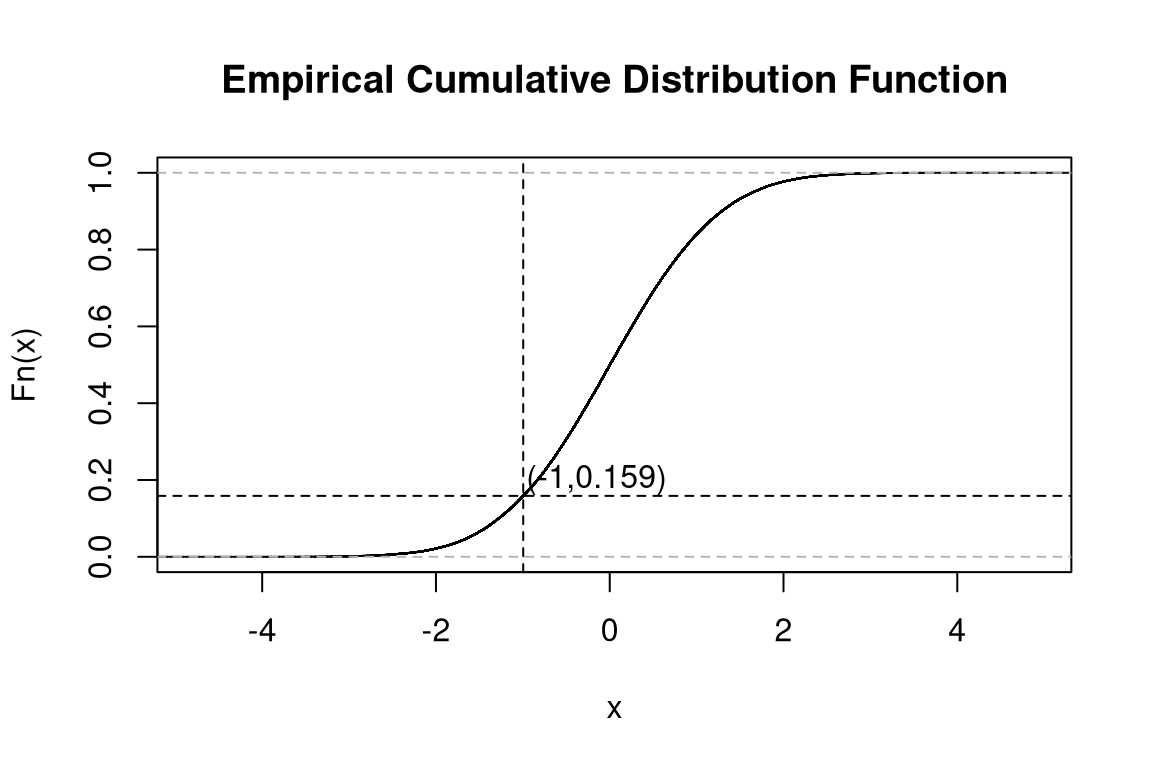
Quantiles of Normal Distribution
qnorm(p, mean = 0, sd = 1)
qnorm(0.158655254)
quantile(ecdf(y),0.158655254)
plot(ecdf(y), main = "Empirical Cumulative Distribution Function")
abline(v = quantile(ecdf(y), 0.158655254), lty = 2)
abline(h = pnorm(-1), lty = 2)
text(x = -0.15, y = 0.2,labels = "(-1,0.159)")
[1] -1 15.86553%
-0.9955969 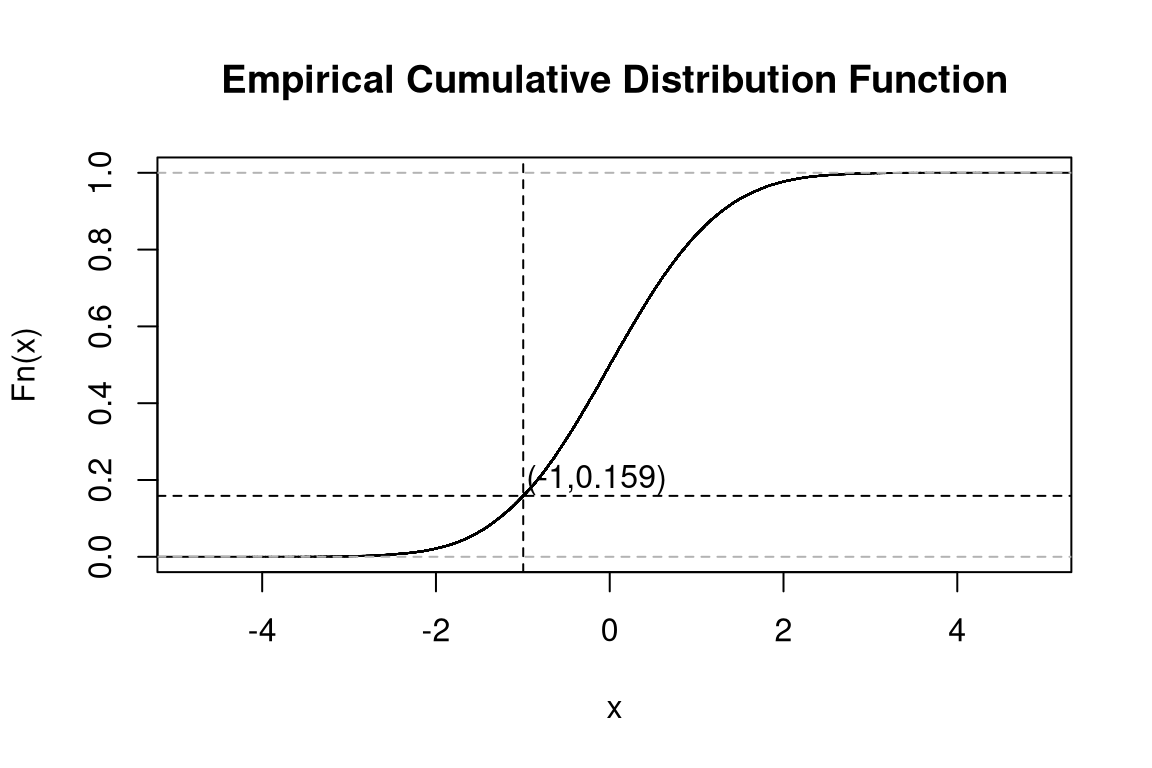
Consider \(X \sim N(0,1)\). It is very easy to compute the following probabilities with R:
- \(P(X \le 0.89)\)
[1] 0.8132671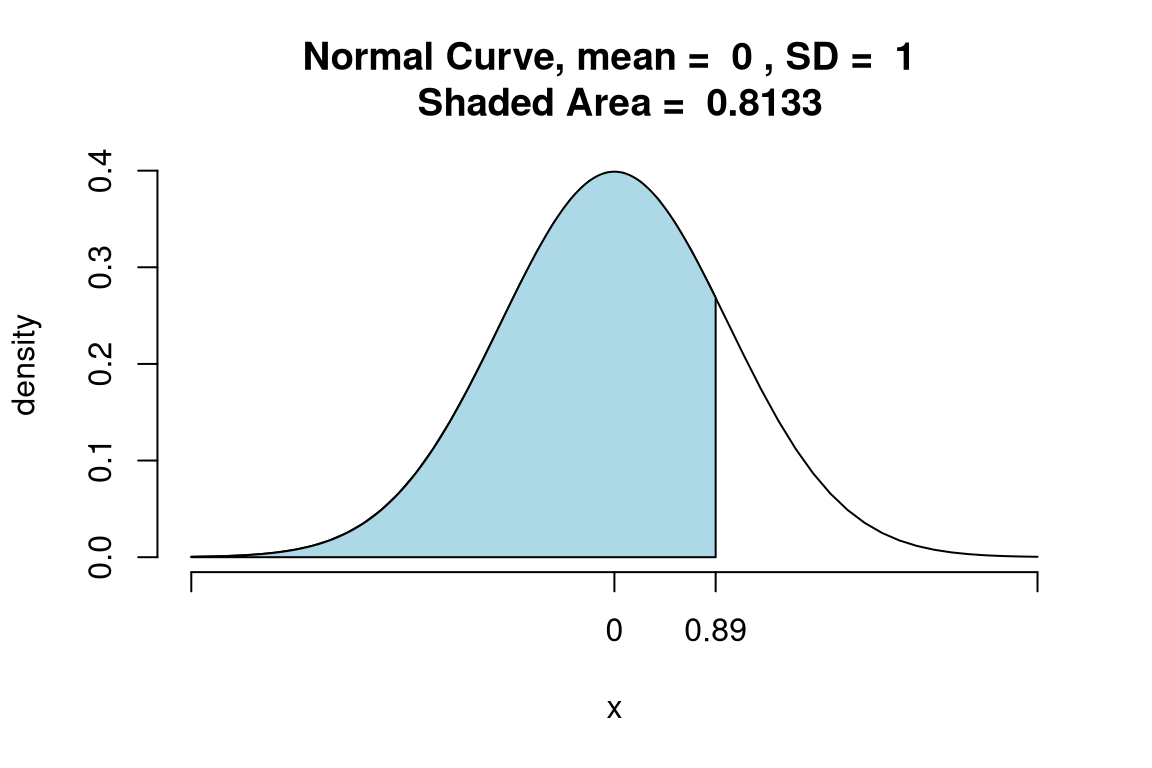
- \(P(X \ge 1.21)\)
[1] 0.1131394[1] 0.1131394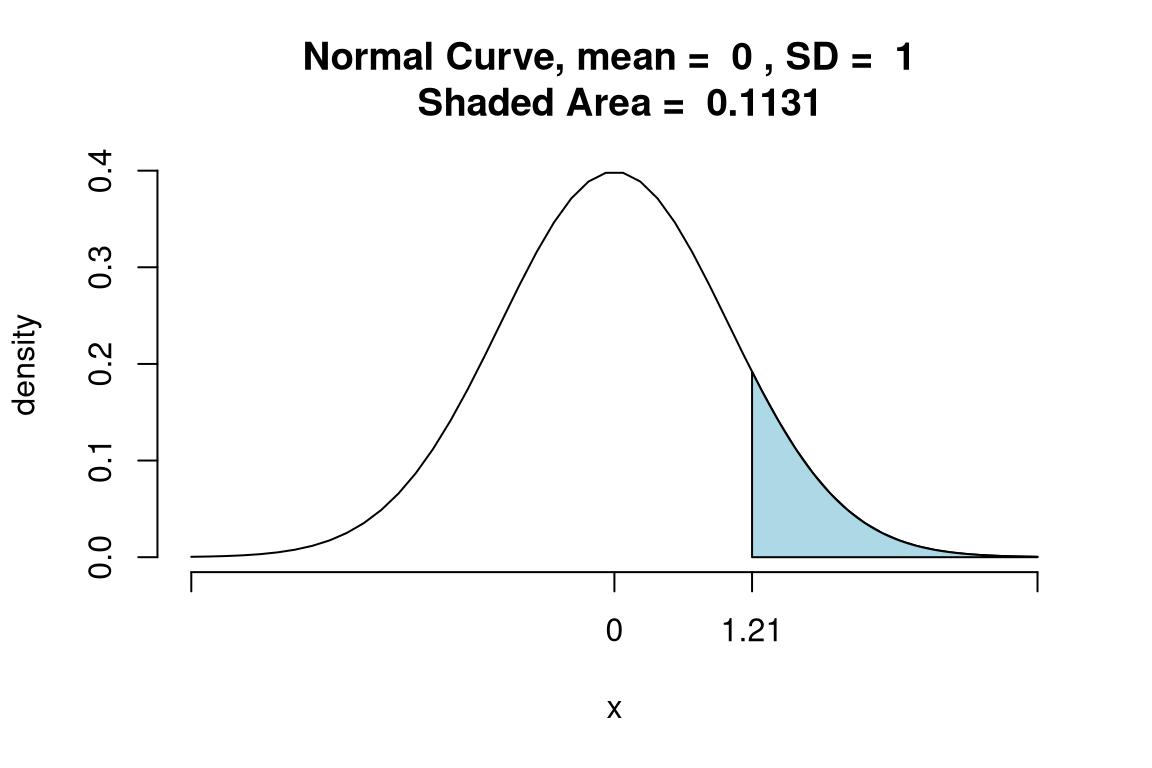
- \(P(-1.02 \le X \le 1.98)\)
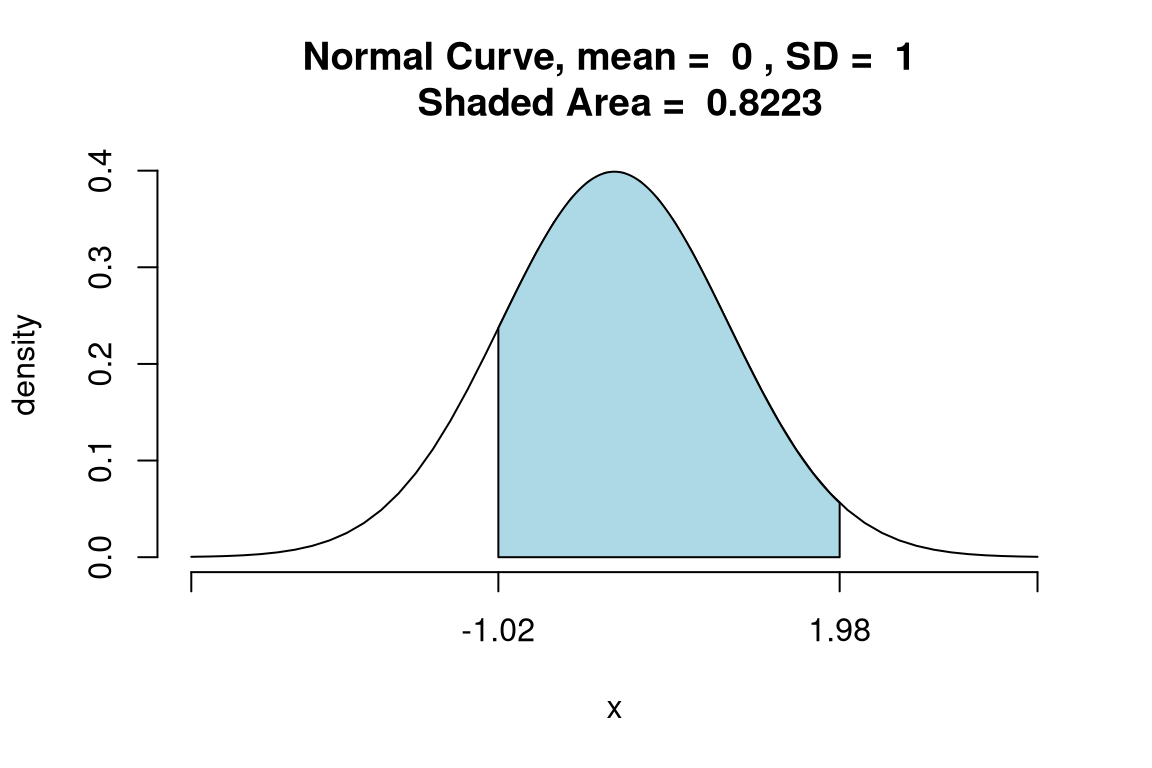
- \(P(\mid X \mid \le 0.92)\)
[1] 0.6424272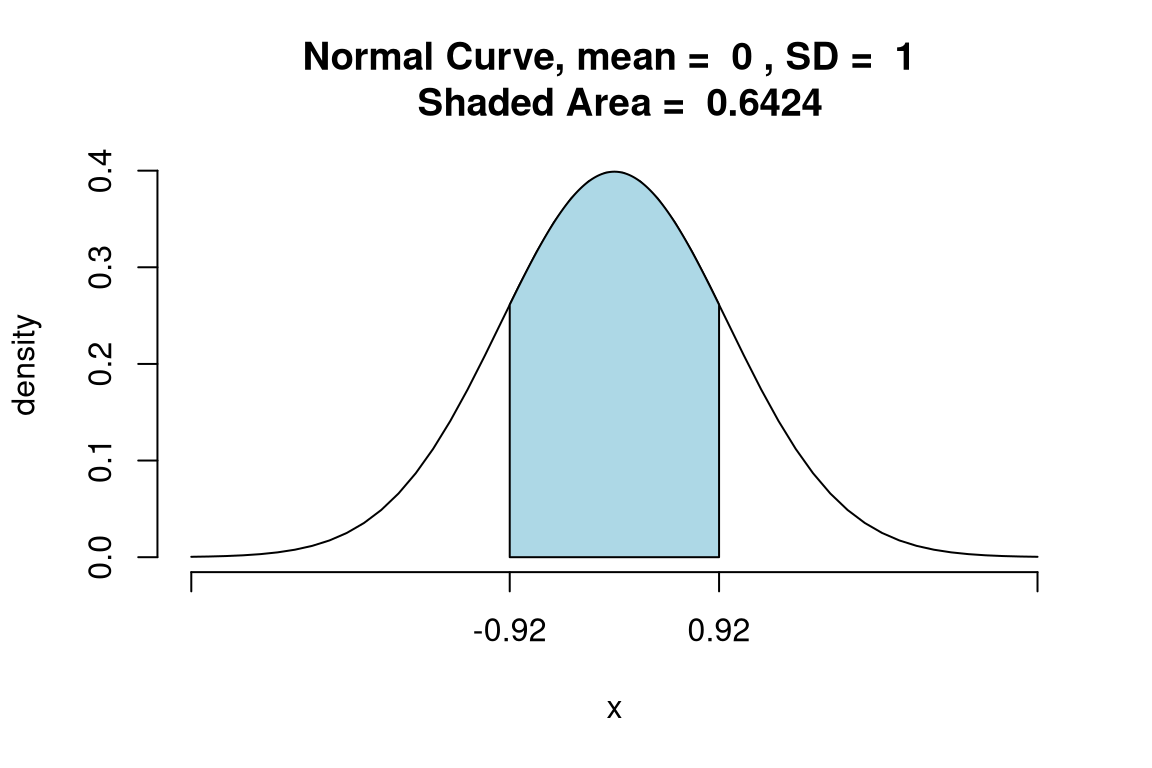
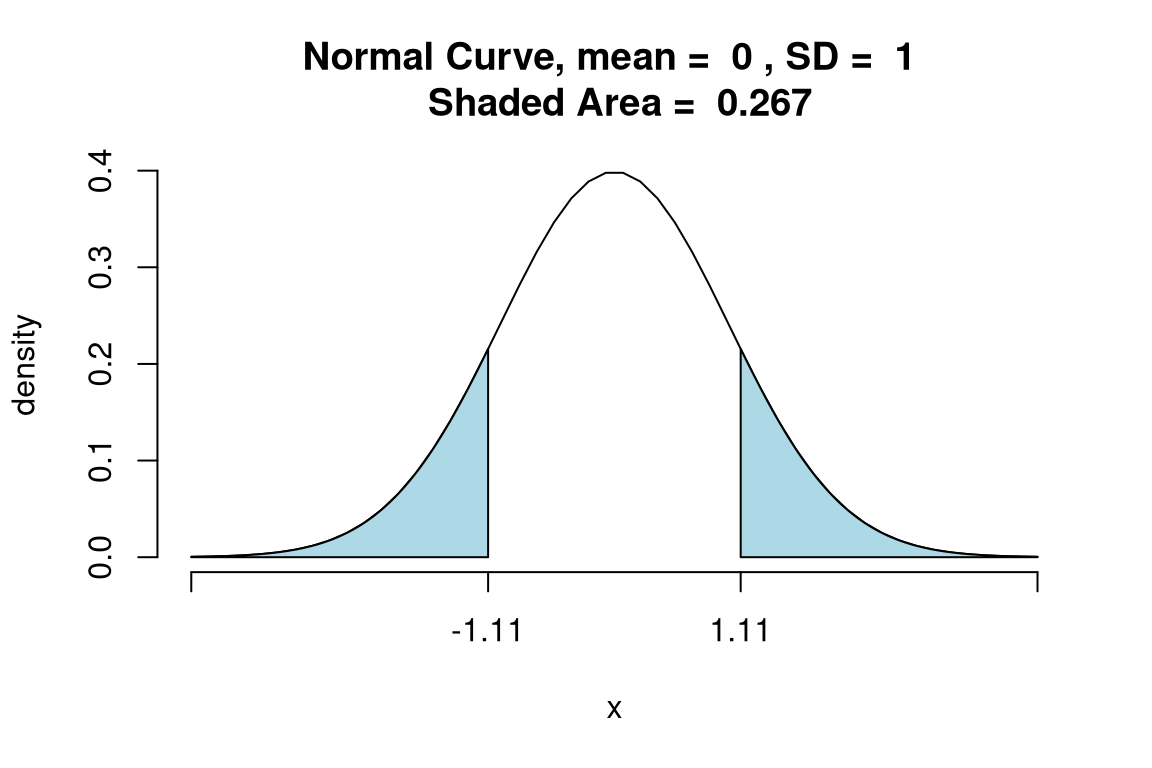
[1] 0.6424272- \(P(\mid X \mid \ge 1.11)\)
[1] 0.266999[1] 0.266999