x <- rnorm(100,mean=1,sd=2)
mean.x <- mean(x)
low <- mean.x - qnorm(0.975)*2/sqrt(100)
up <- mean.x + qnorm(0.975)*2/sqrt(100)
c(low,up)
[1] 0.6694404 1.4534260it is an interval estimate;
we construct an interval following a procedure that, if applied in a large number of replications of the experiment, gives intervals which contain the true value \(1 - \alpha\) of the time;
\(1 - \alpha\) is called confidence level;
usual values are 0.90, 0.95 and 0.99.
x <- rnorm(100,mean=1,sd=2)
mean.x <- mean(x)
low <- mean.x - qnorm(0.975)*2/sqrt(100)
up <- mean.x + qnorm(0.975)*2/sqrt(100)
c(low,up)[1] 0.6694404 1.4534260\(H_0 : \mu = \mu_0\)
\(H_1 :\mu \neq \mu_0\)
t.test(x, mu=\(\mu_0\), alternative='two-sided')
t.test(x, mu=\(\mu_0\), alternative='greater')
t.test(x, mu=\(\mu_0\), alternative='less')
Further examples: greater, less
    One Sample t-test

data:  x
t = 19.082, df = 99, p-value < 2.2e-16
alternative hypothesis: true mean is greater than 1
95 percent confidence interval:
 2.83825     Inf
sample estimates:
mean of x
 3.013445
    One Sample t-test

data:  x
t = 19.082, df = 99, p-value = 1
alternative hypothesis: true mean is less than 1
95 percent confidence interval:
    -Inf 3.18864
sample estimates:
mean of x
3.013445 \(Var[X] \neq Var[Y]\)
\(H_0: \mu_X = \mu_Y\)
t.test(x, y, alternative=c('two.sided', 'less','greater'))
Example:
    Welch Two Sample t-test

data:  x and y
t = 2.5924, df = 128.19, p-value = 0.01064
alternative hypothesis: true difference in means is not equal to 0
95 percent confidence interval:
 0.3542169 2.6379177
sample estimates:
mean of x mean of y
3.621649 2.125582 \(Var[X] = Var[Y]\)
\(H_0: \mu_X = \mu_Y\)
t.test(x, y, var.equal=T,alternative=c('two.sided', 'less', 'greater'))
Example:
    Two Sample t-test

data:  x and y
t = 14.71, df = 198, p-value < 2.2e-16
alternative hypothesis: true difference in means is not equal to 0
95 percent confidence interval:
 1.729849 2.265464
sample estimates:
mean of x mean of y
3.902018 1.904362 \(H_0: \sigma^2_X = \sigma^2_Y\)
\(H_1: \sigma^2_X \neq \sigma^2_Y\)
var.test(x, y, ratio = 1,alternative=c('two.sided', 'less', 'greater'),conf.level = 0.95)
Example:
    F test to compare two variances

data:  x and y
F = 9.3231, num df = 79, denom df = 19, p-value = 1.776e-06
alternative hypothesis: true ratio of variances is not equal to 1
95 percent confidence interval:
  4.165734 17.769619
sample estimates:
ratio of variances
9.323063 \(H_0: p = p_0\)
\(H_1: p \neq p_0\)
prop.test(x, n, p)
x: number of successes
n: total number of trials
p: proportion to be tested.
Example:
# Load preprocessed version of the data saved as .RData file
load(file="myNhanes.RData")
prop.test(sum(mydata$male), length(mydata$male), p=0.5)
    1-sample proportions test with continuity correction

data:  sum(mydata$male) out of length(mydata$male), null probability 0.5
X-squared = 0.2738, df = 1, p-value = 0.6008
alternative hypothesis: true p is not equal to 0.5
95 percent confidence interval:
 0.4898438 0.5177503
sample estimates:
     p
0.5038 \(H_0: p_1 = p_2\)
\(H_1: p_1 \neq p_2\)
prop.test(table(x, y))
x: first (categorical) variable
y second (binary) variable
Example:
    5-sample test for equality of proportions without continuity correction

data:  tbl
X-squared = 13.481, df = 4, p-value = 0.00915
alternative hypothesis: two.sided
sample estimates:
   prop 1    prop 2    prop 3    prop 4    prop 5
0.5218295 0.5082707 0.5292929 0.4605078 0.4881356 Examples:
x <- c("M","F","M","F","M","M","F","F","M")
y <- c("Y","N","N","N","Y","Y","N","Y","N")
chisq.test(x,y)
    Pearson's Chi-squared test with Yates' continuity correction

data:  x and y
X-squared = 0.14062, df = 1, p-value = 0.7077
or, with a contingency table,
Examples:
    Fisher's Exact Test for Count Data

data:  x and y
p-value = 0.5238
alternative hypothesis: true odds ratio is not equal to 1
95 percent confidence interval:
   0.1497998 312.5621395
sample estimates:
odds ratio
  3.764195
. . . or a contingency table
Examples:
    McNemar's Chi-squared test with continuity correction

data:  x and y
McNemar's chi-squared = 0, df = 1, p-value = 1
. . . or a contingency table
\(H_0 : median = md_0\)
we need the package BSDA
Example:
    One-sample Sign-Test

data:  x
s = 38, p-value = 0.3857
alternative hypothesis: true median is not equal to 5
95 percent confidence interval:
 4 5
sample estimates:
median of x
          5

Achieved and Interpolated Confidence Intervals:

                  Conf.Level L.E.pt U.E.pt
Lower Achieved CI     0.9431      4      5
Interpolated CI       0.9500      4      5
Upper Achieved CI 0.9648 4 5\(H_0: median = md_0\)
test based on ranks
Example:
Sign test:
Applicable for ordinal or higher scale level
No distributional assumptions
Low power
Wilcoxon test:
Applicable for discrete or continuous quantitative data
Symmetrical distribution required
Intermediate power
T-test:
Normal distribution required
Highest power
\(H_0: median_1 = median_2\)
non-parametric test for independent samples
package coin (Why extra package and not using wilcox.test? -> https://stats.stackexchange.com/questions/31417/what-is-the-difference-between-wilcox-test-and-coinwilcox-test-in-r)
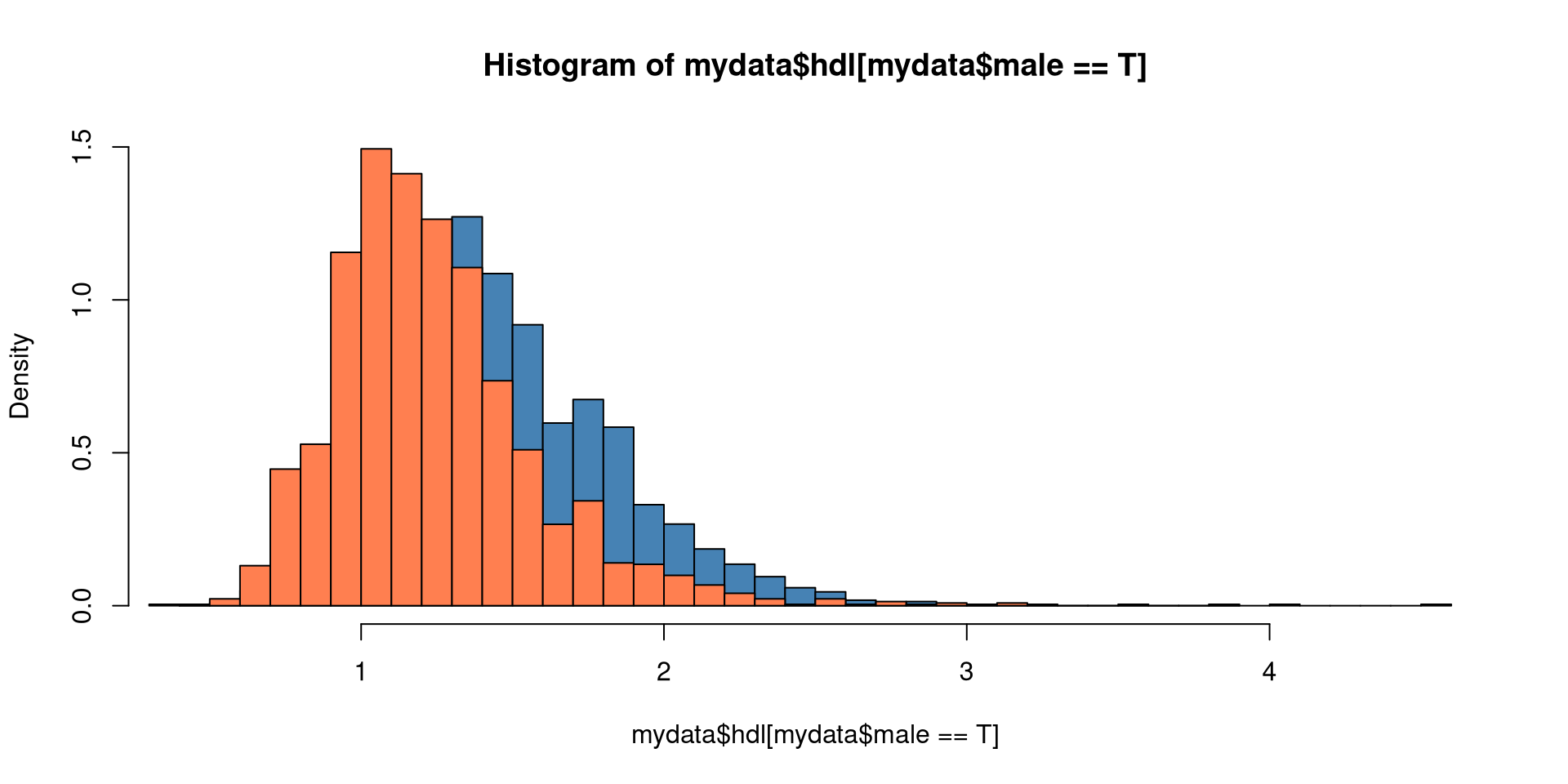
Example hdl in NHANES data (not normal):
hist(mydata$hdl[mydata$male == T], breaks = 40, col = "steelblue", freq = F, ylim=c(0,1.5))
hist(mydata$hdl[mydata$male == F], breaks = 40, col = "coral", add = T, freq = F)
    Asymptotic Wilcoxon-Mann-Whitney Test

data:  hdl by as.factor(male) (FALSE, TRUE)
Z = -21.838, p-value < 2.2e-16
alternative hypothesis: true mu is not equal to 0
    Wilcoxon rank sum test with continuity correction

data:  hdl by as.factor(male)
W = 1520720, p-value < 2.2e-16
alternative hypothesis: true location shift is not equal to 0correlation between x and y
with incomplete observations, we may want to set use =“complete.obs”
based on the argument method, the function cor() computes
Pearson’s r (default)
Kendall’s \(\tau\) (rank based)
Spearman’s \(\rho\) (rank based)
Example:
\(H_1\) is defined through the argument alternative
the argument method sets the correlation coefficient
Example:
Tests in R